

Services /Endpoint Detection and Response (EDR)

Endpoint Detection and Response (EDR)

See the full attack story on the endpoint — and shut it down in a few clicks.

Overview

What we deliver

EDR records endpoint activity, maps suspicious behaviour to MITRE ATT&CK and gives you a guided attack chain rather than a wall of raw alerts. Investigate, isolate, remediate and recover from one place — including restoring encrypted data from backup.

  • Continuous endpoint telemetry and recording
  • MITRE ATT&CK-mapped attack chain visualisation
  • Guided investigation and threat hunting
  • One-click isolation, kill and quarantine
  • Automated remediation with rollback
  • Integrated recovery from backup
Analyst investigating an endpoint attack chain
Problems we solve
  • Alerts with no context and no next step
  • No idea how an attacker got in or what they touched
  • Investigations that take days of engineer time
  • Remediation that leaves data still encrypted

Outcomes

What you can expect

Faster mean time to investigate

Full visibility of the attack path

Complete recovery, not just cleanup

At a glance

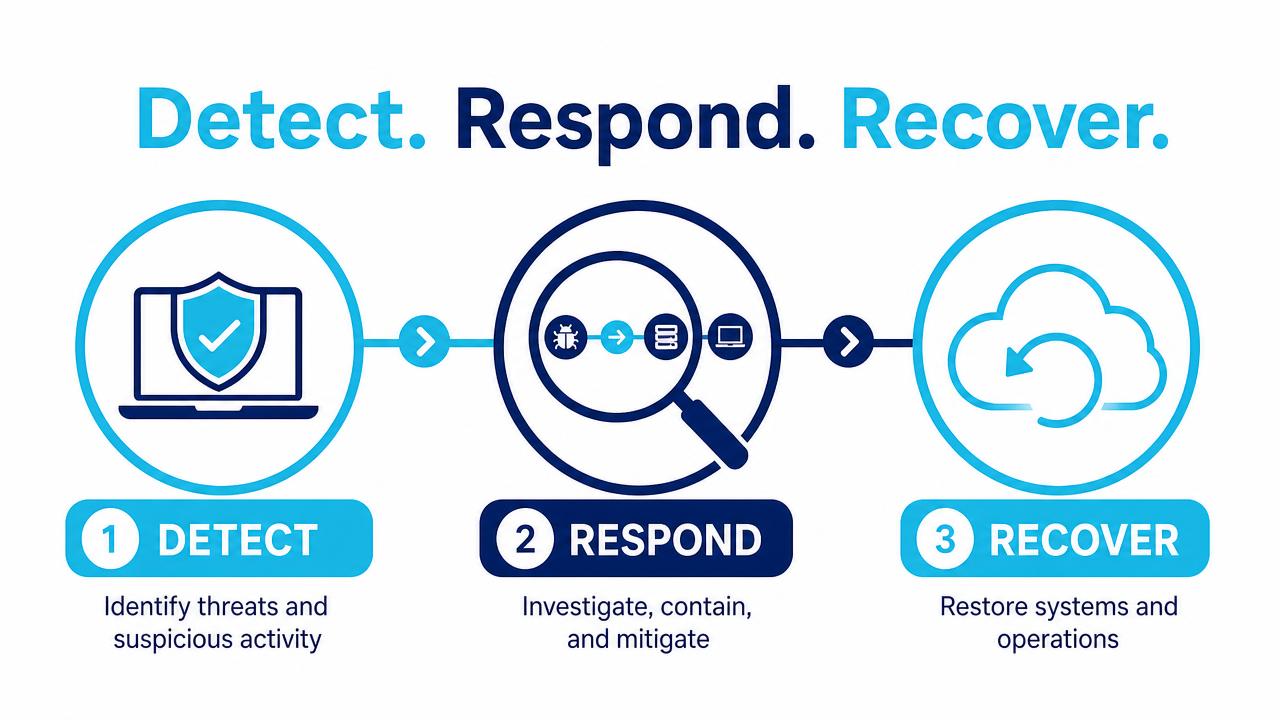
Endpoint Detection and Response (EDR) explained

Detect, respond and recover stages of NG TELECOM managed security

How NG TELECOM detects, responds to and recovers from an attack.

In depth

How the service works

AI-guided attack interpretation

EDR does not hand you raw telemetry. Each incident is presented as an interpreted attack chain: how the attacker got in, what executed, what persistence was created, what data was touched, and which MITRE ATT&CK techniques were used at each step. What used to be a half-day of log correlation for a senior engineer becomes a few minutes of reading a story.

Complete coverage across the NIST functions

Identify, protect, detect, respond and recover are covered by the same platform. Vulnerability assessment and hardening on the identify and protect side, continuous behavioural telemetry on the detect side, and a full set of response actions plus integrated backup restore on the respond and recover side — so an investigation ends with the business working again, not just with a device isolated.

The widest set of response options

From a single incident view our engineers can isolate the endpoint from the network, kill or quarantine a process, remove persistence, run a remote command line or remote desktop session, push a script, roll back ransomware changes, or fail the whole workload over to a recovery server. That range is why EDR here is a business-continuity control rather than only a security control.

Alongside — or instead of — Microsoft Defender

If you already pay for Defender, we can layer AI-guided EDR on top of it and use both signal sets, or consolidate onto one agent. We will tell you honestly which is cheaper and stronger for your licence position rather than defaulting to a rip-and-replace.

FAQs

Common questions

What is the difference between antivirus and EDR?

Antivirus blocks known-bad files. EDR records what happens on the endpoint, detects malicious behaviour that got past prevention, and gives you the full attack chain plus the tools to investigate and reverse it.

Do we need our own security analyst to run it?

No. The attack chain is interpreted for you, and our MDR service can run the whole thing on your behalf.

Does EDR help with cyber insurance?

Yes. Most UK insurers now ask specifically whether EDR is deployed and monitored; we provide the deployment coverage evidence you need.

How is recovery handled after an incident?

Encrypted or altered data is restored from the integrated backup and the endpoint is patched before it is returned to the network.

Book an EDR Demo

A 30-minute review of your IT, security and cloud setup, with clear recommendations. No obligation.