

Services /Failover

Failover

One click to bring critical workloads up in the recovery cloud.

Overview

What we deliver

Orchestrated failover with boot ordering, IP and DNS handling and user access built into the runbook, so bringing production up in the recovery site is a controlled procedure — not an improvised night of guesswork.

  • Orchestrated, ordered failover runbooks
  • Automatic IP, DNS and routing handling
  • Secure remote user access during failover
  • Production and test failover modes
  • Continuous replication with low RPO
  • Controlled, verified failback
Workloads failing over to a cloud recovery site
Problems we solve
  • No documented order to bring systems up
  • DNS and IP changes done manually under pressure
  • Failover depending on one person's knowledge
  • No safe way back once you have failed over

Outcomes

What you can expect

Predictable, repeatable recovery

Anyone on the team can execute it

Clean return to production

At a glance

Failover explained

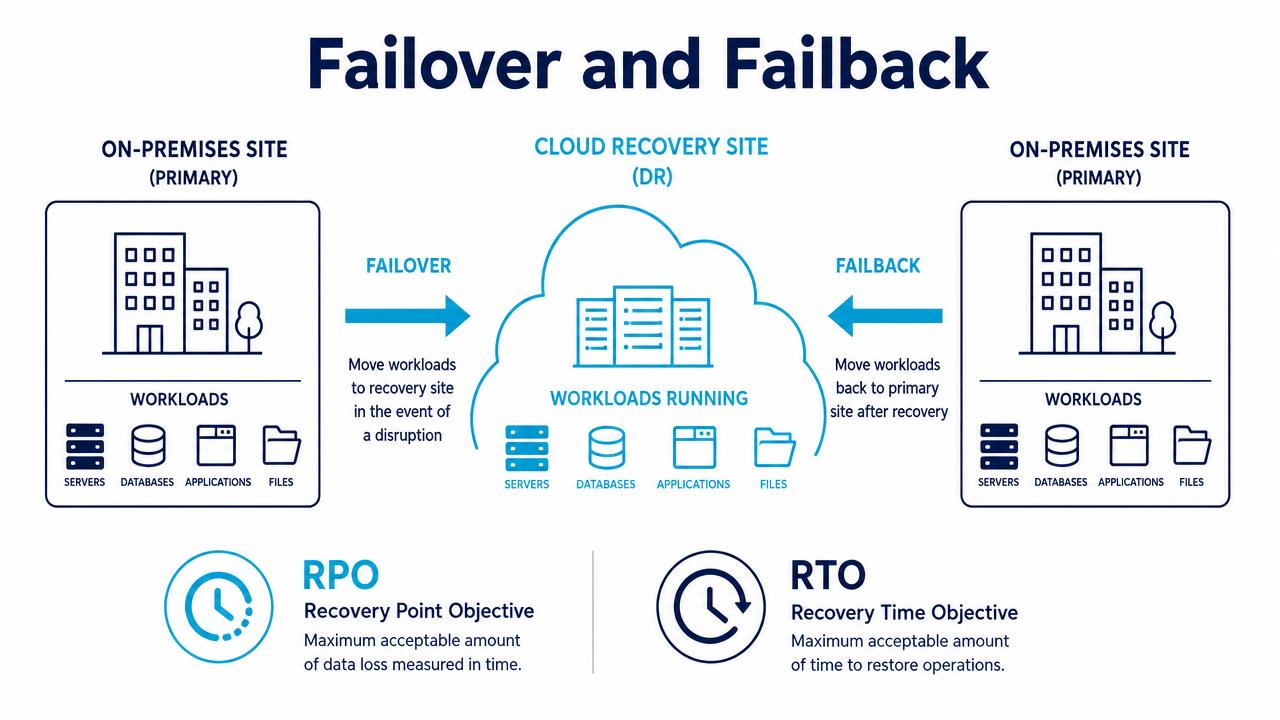
Failover and failback between on-premises site and cloud recovery site with RPO and RTO

Failover to the cloud, keep trading, then fail back — inside agreed RPO/RTO.

In depth

How the service works

Orchestrated, ordered, documented

Runbooks define the exact boot order — domain controllers, then databases, then applications, then user access — with dependencies, credentials, IP and DNS steps and validation checks at each stage. Recovery becomes a procedure any engineer on the team can execute under pressure.

Test failover without touching production

Automated test failover starts the recovery servers in an isolated network so production is entirely unaffected. We validate boot, services, application login and data currency, capture evidence, then tear the sandbox down.

Production failover when it is real

In a genuine incident the same runbook runs for real, with our engineers on the call, user access re-pointed through VPN or published access, and a status cadence to your leadership so the business knows where it stands.

FAQs

Common questions

How often should we test failover?

At least annually, and after any significant infrastructure change. We schedule it as part of the service.

Does test failover affect live systems?

No — it runs in an isolated network with no route to production.

Who runs the failover in a real incident?

Our engineers, following the agreed runbook, with your nominated contact on the bridge.

Book a Failover Planning Session

A 30-minute review of your IT, security and cloud setup, with clear recommendations. No obligation.